The Governed Data Foundry: The Ten-Layer Stack
A layer-by-layer exposition of the ten responsibilities, four zones, control-flow properties, governed action record, conformance model, and build sequence of the Governed Data Foundry.
Surendra Reddy24 min read
What the Stack Is
The Governed Data Foundry is ten logical responsibilities arranged as a closed loop, where each responsibility answers exactly one question. The questions are the architecture. The boxes are only a convenient way to draw them, and an implementation is free to consolidate several responsibilities into a single product without violating anything. What an implementation may not do is fail to say which of its components answers which question, because that failure is the signature of a system that has collected capabilities without acquiring a structure.
The stack differs from a data architecture in one respect that changes everything downstream of it. A data architecture moves information upward toward comprehension and stops there, on the assumption that a human will carry comprehension the rest of the way into action. This architecture keeps the upward path, adds a governed downward path from comprehension into action, and then returns the consequence of that action into the layers that decide what may happen next. The loop is the point. A stack that ends at comprehension is a reporting system with agents bolted on, and it will produce exactly the failures that agentic deployments are now producing.
This Journal is an exposition of that larger architecture rather than a new model. It descends from The Governed Data Foundry: A Reference Architecture for Governed Enterprise State in the Agentic Era, v3.5, and introduces no layer, invariant, or abstraction that the parent architecture does not already carry.
Two further framings are worth stating before the layers. First, this is a substrate rather than a strategy: it takes no position on which workloads should be delegated to machines, only on what must be true before any of them is. Second, it is deliberately unglamorous at the top and the bottom, because Layers 1 through 3 are already well served by the market and Layer 10 is where almost nobody is building.
The Architecture in One View
The reference architecture is easiest to understand when the ten responsibilities are seen together. The figure below shows the Foundation on the left, the interpretive boundary beneath it, the governed decision and control plane to the right, and Layer 10 extending across the bottom as the return path through which consequence becomes institutional memory.
Figure 1
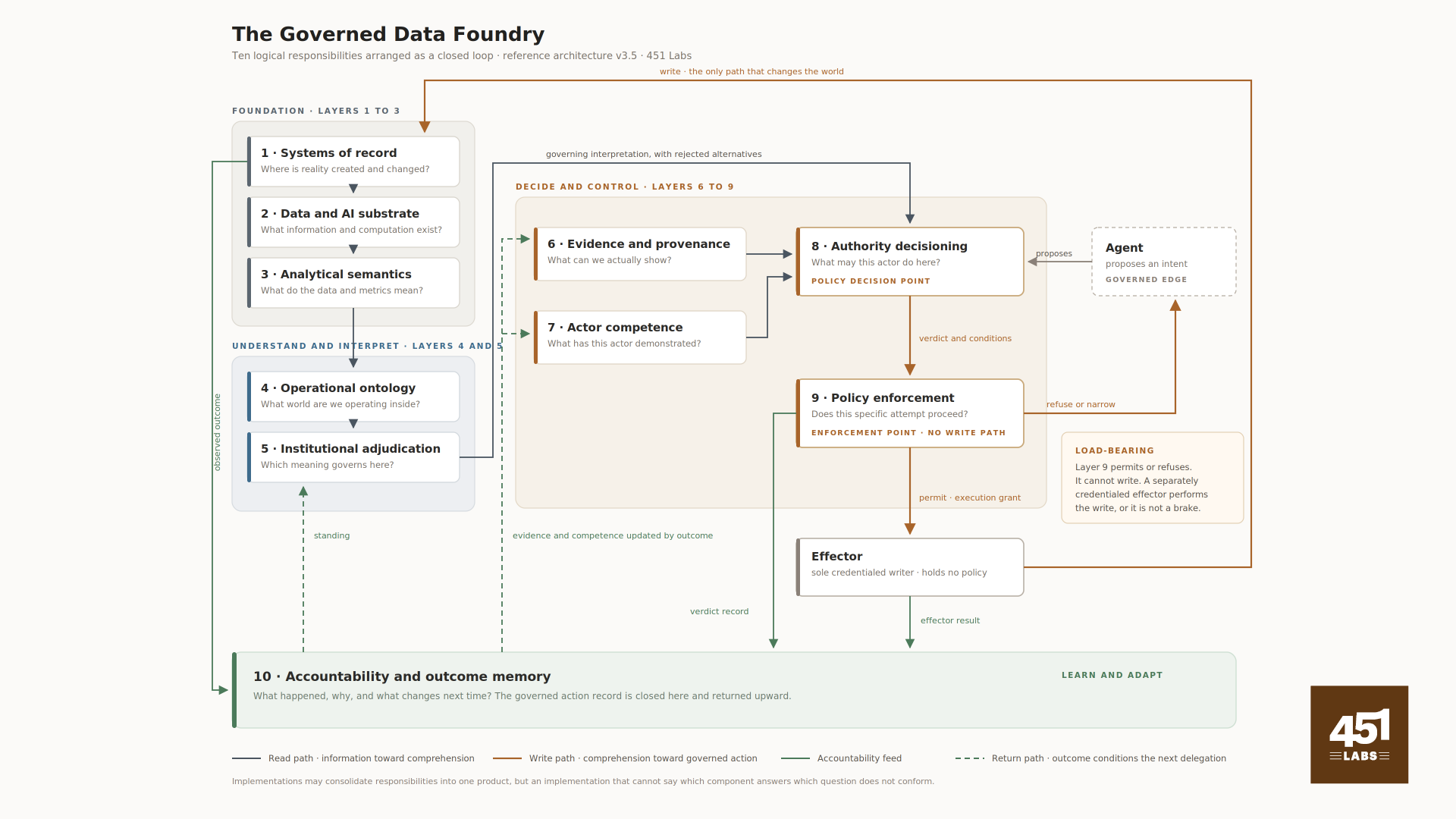
Figure 1. The Governed Data Foundry v3.5. Ten logical responsibilities arranged as a closed loop from enterprise reality through comprehension, authority decisioning, policy enforcement, effect, accountability, and institutional learning.
The figure is deliberately more than a layer diagram. The dark path represents information moving toward comprehension. The orange path is the governed write path from comprehension toward action. The solid green paths feed enforcement, effect, and observed state into accountability, while the dashed green paths return outcome upward so that evidence, competence, and institutional standing can change over time.
This reading is important because the Foundry is not simply an extension of the modern data stack. The architectural shift occurs when intelligence can move from understanding enterprise state to proposing changes to it. At that point, the path from comprehension to consequence can no longer remain implicit.
The Four Zones
Layers 1 through 3 are the Foundation. Their job is to make enterprise information reliable and semantically useful, and the market has spent thirty years and enormous capital solving them. An enterprise adopting this architecture almost certainly already has these layers in some form, which means the Foundation is an integration surface rather than a build.
Layers 4 and 5 are Understand and Interpret. Here information becomes operating context, and then one interpretation of that context acquires institutional standing over its rivals. The separation between these two is the least obvious move in the architecture and the one that most implementations collapse.
Layers 6 through 9 are Decide and Control. Evidence and competence condition a decision, the decision produces a verdict, and the verdict is enforced at a point that stands between the proposal and the world. This zone is where authority becomes machine-legible rather than a matter of who has credentials.
Layer 10 is Learn and Adapt, and it is the only layer whose output is another layer's input rather than an action. It closes the loop by returning consequence into evidence, competence, and standing.
The Layer Table
| Layer | Responsibility | Governing question | Zone |
|---|---|---|---|
| 1 | Systems of record and operational systems | Where is reality created and changed? | Foundation |
| 2 | Data and AI substrate | What information and computation are available? | Foundation |
| 3 | Analytical semantics and governance | What do the data and metrics mean? | Foundation |
| 4 | Operational ontology and context | What world are we operating inside? | Understand and Interpret |
| 5 | Institutional adjudication | Which meaning governs here? | Understand and Interpret |
| 6 | Evidence and provenance | What can we actually show? | Decide and Control |
| 7 | Authority lineage and actor competence | What has this actor demonstrated, and on whose behalf? | Decide and Control |
| 8 | Authority decisioning | What may this actor do here? | Decide and Control |
| 9 | Policy enforcement | Does this specific attempt proceed? | Decide and Control |
| 10 | Accountability and outcome memory | What happened, why, and what changes next time? | Learn and Adapt |
The Layers
Layer 1: Systems of Record and Operational Systems
This layer is where reality is created and changed: the ledgers, the order books, the identity directories, the control systems, the clinical and industrial systems that hold the state an institution is accountable for. It is the only layer that anything in this architecture is permitted to write to, and even then only through a single credentialed effector. Everything above it is, in the end, an elaborate apparatus for deciding whether a write to Layer 1 should occur.
The architectural discipline here is negative rather than positive. This layer must not be reachable by any path that skips the enforcement point, which is why the effector's credentials exist nowhere else in the stack. The common failure is an integration built for convenience, a service account shared with an orchestration framework, that silently creates a second write path. When that happens the accountability record at Layer 10 remains syntactically complete and becomes semantically false, which is worse than having no record at all.
This is the one condition in the stack that does not degrade gracefully. Evidence can improve, policies can become richer, and competence models can mature, but an alternate path to consequence means the architecture cannot know whether the governed action record describes all of the consequential actions that occurred.
Layer 2: Data and AI Substrate
This is the compute and storage estate: lakehouses, warehouses, streams, vector and graph stores, feature stores, model serving, and the retrieval machinery that agents actually touch. The architecture takes no position on any of it, and deliberately so. Storage engines, query planners, model training, model selection, and agent memory strategies are all specified elsewhere by people who do that work well, and reinventing them inside a governance architecture is how governance architectures become products nobody adopts.
What this layer owes the layers above it is reproducibility rather than merely availability. Every reference to a mutable dataset, model, or reference table must carry enough snapshot information to reproduce the value that was actually used at decision time. A stable identifier makes a reference addressable; it does not make it reproducible, and conflating the two produces a decision record that points confidently at data that has since changed underneath it.
Layer 3: Analytical Semantics and Governance
This layer answers what the data and the metrics mean: entities, metrics, dimensions, hierarchies, lineage, and the access policy that travels with them. It is the semantic layer as the market now understands it, and the market is converging on it fast. The correct posture is to treat Apache Ossie as the acceptance contract for this layer rather than as a competitor to it, because a published reference architecture that invents its own interchange format at the exact moment the industry standardizes one has chosen to be right instead of adopted.
The limit of this layer is what makes Layers 4 and 5 necessary. Analytical semantics tell you what revenue means in a metric definition. They do not tell you what world you are operating inside when a specific agent proposes a specific irreversible action against a specific counterparty in a specific jurisdiction, and they do not adjudicate between two definitions of revenue that are both defensible and both in use.
Layer 4: Operational Ontology and Context
Layer 4 answers what world we are operating inside. It carries the entities, relationships, states, obligations, and situational bindings that an actor needs in order to form a proposal that is even coherent, let alone permitted. It is the difference between knowing what a customer record contains and knowing that this customer is inside a regulated remediation window, represented by counsel, and subject to a contractual notice period that has eleven days left on it.
This is the semantic memory role, realized in the 451 canon as Ana. Its output is a context, not a permission. Intelligence proposes and never authorizes, which is one of the sharper invariants in the parent document and the one that keeps this layer from quietly becoming the authority layer by virtue of knowing the most.
That separation becomes increasingly important as semantic and ontology systems become more operational. The richer the representation becomes, the easier it is to confuse knowing the world with possessing the authority to decide what may happen inside it.
Layer 5: Institutional Adjudication
Layer 5 answers which meaning governs here, and it is the layer most implementations do not know they are missing. Enterprises do not suffer from a shortage of definitions; they suffer from a surplus of legitimate ones. Finance, revenue operations, and the regulatory function each hold a defensible reading of the same concept, and in a human institution the conflict is resolved continuously and invisibly by seniority, precedent, and meeting. A machine cannot participate in that resolution, so it must be given the result of it.
The artifact this layer produces is the interpretation warrant: the record of which interpretation governs a specific consequential decision, under whose standing, for what scope, and, critically, which alternatives were rejected. Recording the rejected alternatives is what turns the warrant from an assertion into something reviewable, because an auditor's first question is never what you decided but what else was on the table. This layer is deliberately unassigned in the 451 implementation mapping, and that gap is honest rather than accidental: adjudication is an institutional act, not a piece of software, and the architecture specifies the artifact it must produce without pretending the act itself can be automated.
The distinction matters because certification and warrant are not the same thing. A semantic layer may establish that a definition is legitimate and institutionally certified, while adjudication establishes that this particular legitimate definition governs this particular class of consequential decision.
Layer 6: Evidence and Provenance
Layer 6 answers what we can actually show, as distinct from what was reported to us. Its artifact is the evidence envelope asserted at decision time, carrying claim types, information states, and staleness budgets, so that a decision made on a three-hour-old inventory reading is recorded as having been made on a three-hour-old inventory reading rather than on inventory. The distinction between evidence and testimony is the whole substance of this layer, and it is the concept that Clearstory realizes in the canon.
One correction from v3.5 is load-bearing here and easy to get backwards. Evidence conditions the extent of a delegation, but it does not originate authority. A perfectly evidenced proposal from an actor with no standing is still refused, and a thinly evidenced proposal from an actor with ample standing is narrowed rather than blessed. Architectures that let evidence quality substitute for standing end up with a system where the most confident component wins, which is the failure mode of every insight engine that has ever been sold into an enterprise.
That epistemic discipline is what separates evidence suitable for consequential action from ordinary analytical input. Once policy depends on a fact, the architecture must preserve not only the value but the state under which that value became knowable.
Layer 7: Authority Lineage and Actor Competence
Layer 7 answers what this actor has demonstrated and on whose behalf it is acting. These are two questions that must be answered together and never merged. Delegation lineage is the chain of contracts by which a principal's authority reached this actor for this task class, and competence is the retained record of what the actor has actually accomplished in that task class under comparable context. Entitlement without demonstrated competence is how organizations grant an agent production write access on day one; competence without lineage is how a capable agent acts on behalf of nobody in particular.
The scoring construct here is the Agent Earned Authority Score, realized in the canon as Hubli. The essential property is that the score is scoped to a task class and a context band rather than being a global reputation number, because an agent that is excellent at reconciliation has demonstrated nothing whatsoever about its judgment in customer communication. The portable competence assertion extends this across organizational boundaries, allowing an actor's demonstrated competence to travel without its authority travelling with it, which is what makes the federation position operable. Intelligence federates upward and authority stays local, and this is the construct that stops that principle from being a slogan.
This is the point at which the architecture moves beyond identity and entitlement. Identity establishes who or what the actor is and what it can technically reach. Layer 7 establishes whose institutional authority is being exercised and what the actor has demonstrated strongly enough to justify the current extent of delegation.
Layer 8: Authority Decisioning
Layer 8 is the policy decision point, and it answers what this actor may do here. It takes the interpretation warrant from Layer 5, the evidence envelope from Layer 6, the lineage and competence from Layer 7, the proposal from the agent, and the consequence and reversibility classification of the action itself, and it returns a verdict with conditions. The verdict is rarely binary in practice. Most of the value in this layer sits in narrowing: permitting a proposal at reduced scope, under a lower monetary ceiling, or with a required second party, rather than choosing between an unqualified yes and a flat refusal.
Two properties keep this layer honest. It must evaluate against the state available at decision time rather than current state, bound to a declared evaluation time rather than to any target system's ambient clock, because a decision reconstructed from today's data is not a reconstruction of anything. And it must be able to declare a predicate unresolved rather than defaulting it, since a policy engine that silently treats an unevaluable condition as satisfied has converted a governance system into a rubber stamp. In the canon this layer is Pola, expressed in the Kata policy language, whose lowering classification exists precisely so that a semantic predicate written by a policy author can be executed against a real substrate without being quietly reinterpreted on the way down.
The Foundry therefore treats authority decisioning as a distinct responsibility rather than as another feature inside the agent runtime. The decision point is allowed to reason about permission, but it is deliberately denied the ability to change enterprise state.
Layer 9: Policy Enforcement
Layer 9 answers whether this specific attempt proceeds. It is the policy enforcement point, it sits on the path between the proposal and the world, and it holds no write path of its own. On permit it hands a signed execution grant to a separately credentialed effector, together with an idempotency key derived from the governed action record identifier. On refusal it returns the refusal, or the narrowed scope, to the proposing actor.
The separation between Layer 8 and Layer 9 is not fastidiousness. A decision point that can also enforce is unauditable, because there is no artifact standing between the reasoning and the effect. An enforcement point that can also write is not a brake, because the thing that makes a brake a brake is that it cannot also be the engine. In the canon these are Pola and the Governor, and collapsing them is a defect rather than a simplification.
There is one item in the conformance checklist whose failure invalidates every other item: no path may exist from an agent to an effector that omits the enforcement point. Everything else in this architecture degrades gracefully. This one does not.
Layer 10: Accountability and Outcome Memory
Layer 10 answers what happened, why, and what changes next time. It is fed by three sources rather than one: the enforcement verdict, the effector's result, and the observed outcome from the system of record. A record built from the system of record alone captures what changed without capturing what was permitted, and therefore cannot reconstruct a decision, which is the entire purpose of holding the record. In the canon this is Actra, the governed event stream.
The word that separates this layer from a log is memory. Outcomes recorded here must demonstrably alter subsequent state at Layers 5, 6, and 7: an interpretation that keeps producing bad outcomes loses standing, an evidence source that keeps proving stale has its staleness budget tightened, and an actor's competence score moves as a function of retained outcome rather than of vendor assertion. An outcome record with no downstream consumer is a log, and the enterprise already has more logs than it can read.
The purpose of Layer 10 is therefore not simply to satisfy an audit requirement. It is to make the institution capable of learning from the actions it has already permitted and to allow that retained experience to condition the next boundary of delegated authority.
The Two Properties That Carry the Control Flow
The first is that enforcement does not route into the systems of record. The Governor permits or refuses, and a separately credentialed effector performs the write. This is drawn explicitly in the diagram because an earlier version of it drew enforcement writing directly into Layer 1, which handed the enforcement point a write path and quietly destroyed the property that makes the whole architecture governable.
The second is that accountability is fed by the verdict, the effector result, and the observed outcome. These three can disagree, and the disagreement is the most valuable signal the architecture produces. A permitted action whose effector reports success but whose system of record shows no corresponding change is the signature of a broken integration or a false report, and only a three-source accountability layer can see it.
These two properties explain why the architecture cannot be reduced to policy checks embedded inside an agent runtime. The point is not merely that a decision occurred. The point is that institutional permission, enforcement, execution, and observation remain independently reconstructible.
The Governed Action Record
The central noun of the architecture is the governed action record, which is not a log entry but the complete artifact that makes a machine action reconstructible. Every layer either contributes a field to it or consumes one, which is a useful test when evaluating whether a proposed component belongs in the stack at all. If a component neither contributes to nor consumes from this record, it is infrastructure rather than architecture.
For any governed action, a conforming implementation can produce the governing interpretation warrant with its rejected alternatives, the evidence envelope as asserted at decision time with claim types and staleness budgets, the actor identity and its competence score for the relevant task class and context band, the delegation contracts and their classifications, the policy version evaluated, the verdict with its conditions and any unresolved predicates, the enforcement outcome, the effector and idempotency key, the reversibility class and compensation handle, the resulting state change, and the observed outcome. An implementation that cannot produce all of these has not built this architecture, whatever else it has built.
This distinction matters because most existing observability and agent-tracing systems capture only pieces of the chain. They may show what the agent thought, what tools it invoked, or what state changed, but not the full institutional basis on which the action was permitted.
The Write Path in Six Steps
The agent proposes an intent against the operational context. The decision point evaluates the proposal against the warrant, the evidence envelope, the competence score, the consequence class, and the reversibility class, and returns a verdict with conditions. The enforcement point enforces that verdict and, on permit, hands a signed execution grant to the effector with an idempotency key issued at decision time. The effector executes against the system of record using credentials that exist nowhere else. The system of record's observed response and the effector's result both flow to the accountability stream. Compensation, where later required, runs as a new governed action rather than as an undo.
Three failure modes get explicit architectural treatment rather than operational handling. Partial failure across a multi-step action is a saga with per-step compensation and an explicitly marked pivot, where the authority decision covers the whole saga including its pivot, because an actor authorized for every step individually may not be authorized for the sequence. Retry after crash is handled by the idempotency key, without which a resumed workflow can double-execute a payment and leave an accountability record showing one action where two occurred. Compensation foreclosed is the case where the pivot has been passed and the action is terminal, and the only remaining architectural answers are escalation and disclosure.
The write path is therefore not simply a downstream application concern. Once intelligence is capable of creating consequential state, the data architecture must govern the path by which proposed state is allowed to become real.
Conformance in Short
Conformance rests on seven properties. Reconstruction, meaning the full governed action record can be produced for any governed action. Separation, meaning each of the sixteen invariants holds at the point named rather than by convention, with the credential separation of Invariants I9 through I12 demonstrable by inspection. Referential stability, meaning every business concept referenced by a warrant or policy resolves through an identifier that survives renaming and platform migration. Reproducibility, meaning every mutable reference carries snapshot information sufficient to reproduce the value used. Temporality, meaning reconstruction uses decision-time state bound to a declared evaluation time. Closure, meaning Layer 10 outcomes demonstrably alter subsequent Layer 5, 6, and 7 state. And non-bypass, meaning no path from agent to effector omits the enforcement point.
The scoped verdict rule that governs component selection follows directly. If a component makes the full reconstruction possible, Proceed. If it improves reconstruction fidelity or closes the outcome loop, Accelerate. If it collapses two of the separations, Redesign. If it places the decision, the enforcement, and the write in the same failure domain, Stop.
The purpose of a conformance model is to prevent the architecture from becoming a vocabulary that every product can claim. A reference architecture is only useful if an implementation can fail it.
Where to Start
The instinct is to build upward from the Foundation, and it is wrong here, because Layers 1 through 3 are the layers an enterprise already has and the layers a well-funded market is actively completing. The durable core of this architecture is Layers 5 through 10, and among those, Layer 10 is the correct first build. It is the only layer that produces value before any of the others exist, since an accountability record of what agents did, what they were permitted to do, and what actually resulted is immediately useful even in an environment with no policy decision point at all. It is also the layer that generates the evidence needed to make Layers 6 and 7 more than assertions, because competence cannot be scored before outcomes have been retained.
The sequence that follows from that is Layer 10, then Layer 6, then Layer 9, then Layer 8, then Layer 7, then Layer 5. Enforcement precedes decisioning in this ordering because a crude enforcement point with a simple policy is safe, while a sophisticated decision point with no enforcement is theatre. Layer 5 comes last not because it matters least but because it is the layer that requires the institution to have decided something about itself, and that is the one input no architecture can supply.
The architecture is therefore grown from consequence inward rather than from an abstract enterprise model outward. That ordering reduces both technical and institutional risk because it allows the Foundry to learn from real operating behavior before the enterprise increases the amount of authority delegated to machines.
Mapping to the 451 Labs Implementation
The reference architecture is implementation-neutral. For readers tracing it against the author's own work, the responsibilities map as follows. All are working names for systems under active validation, none is generally available, and none is required for conformance.
| Layer | Reference role | Implementation component |
|---|---|---|
| 4 | Operational ontology and context | Ana |
| 5 | Institutional adjudication | unassigned |
| 6 | Evidence and provenance | Clearstory |
| 7 | Authority lineage and actor competence | Hubli, with the Agent Earned Authority Score |
| 8 | Authority decisioning (PDP) | Pola, with the Kata policy language (KS-001) |
| 9 | Policy enforcement (PEP) | the Governor |
| 10 | Accountability and outcome memory | Actra |
The enclosing governed operating machine is ADAM, the Adaptive Development and Assurance Machine.
The distinction between reference architecture and implementation remains important. The ten responsibilities are intended to survive product changes, vendor consolidation, and the evolution of the 451 implementation itself.
Correspondence with the Six Institutional Functions
The Convergent Enterprise describes the institution through six interdependent functions. This stack is the substrate beneath them, and the correspondence is normative for both documents.
| Function | Layers | Note |
|---|---|---|
| Reality | 1, 2 | Signals describing the world as it exists, and the substrate that holds them. |
| Intelligence | 3, 4 | Interpretation and belief formation. Intelligence proposes and never authorizes. |
| Authority | 5, 7, 8 | Standing, lineage, competence, and the decision. |
| Enforcement | 9 | The boundary applied before execution rather than beside it. |
| Action | effector | The only component that changes the world, and it holds no policy. |
| Verification and learning | 6, 10 | Establishing what occurred rather than what was reported, and returning it to condition the next delegation. |
The six-function model folds adjudication into Authority and has no counterpart to Layer 5 as a separate function. This architecture separates them, because meaning and permission have different enforcement points. That separation is one of the places where the ten-layer model deliberately becomes more precise than the institutional model above it.
What This Stack Does Not Cover
Stating the boundary keeps the model useful. This architecture does not specify how models are trained, selected, evaluated, or served. It does not specify agent planning, orchestration, or memory strategies. It does not specify data storage, transformation, or query execution. It does not define an identity protocol, a policy language, a semantic interchange format, or an expression language for semantic predicates, all of which exist or are being standardized elsewhere and should be adopted rather than reinvented. MCP and A2A are integration edges this architecture governs, not components of it, and no governance decision may be delegated across them.
The Foundry is therefore intentionally narrower than an AI operating system and broader than a conventional data platform. Its concern is the institutional machinery required at the point where enterprise understanding becomes consequential machine action.
A Note on AI-Assisted Research and Intelligence Provenance
Portions of the synthesis supporting this note were produced with AI assistance under the 451 Labs Writing Covenant. Astra, the Adaptive Strategic Thesis Reasoning Agent, and Clearstory, the knowledge and intelligence provenance system that is the primary realization of the Astra thesis, are theses under active development at 451 Labs and are not shipped products. All analytical judgments remain the author's own.
The architecture itself remains implementation-neutral. The ten layers are not a claim that one organization should own the entire stack, but a statement that when machines are allowed to change consequential enterprise state, these ten questions must remain answerable and the path from comprehension to action must remain reconstructible.