The Governed Data Foundry and the Job Still Up for Grabs
My analysis of the emerging contest among systems of record, general agents, vertical AI, and the institutional learning layer that the Governed Data Foundry is designed to govern.
Surendra Reddy27 min read
Abstract
A recent a16z argument about systems of record and vertical AI, written by Seema Amble, sharpened an architectural question I have been working on through the Governed Data Foundry. Their argument begins with a useful correction to the common disruption narrative: AI does not necessarily make incumbent systems of record less important. As agents do more work through Salesforce, Docusign, Jira, SAP, ServiceNow, and other operational systems, the records, permissions, and actions controlled by those systems may become more valuable. At the same time, a general agent such as Claude or Codex can increasingly become the front door to work that spans those systems, separating the interface from the underlying record.
I agree with much of that framing. I also think it stops one layer too early. The real strategic problem is not only who owns the record, who owns the interface, or even who becomes best at performing the job. Once agents begin exercising judgment and taking consequential action, the institution needs a durable account of how evidence became a decision, whose authority was exercised, which constraints governed the action, how the boundary was enforced, what actually happened, and what the outcome should change next time.
The a16z distinction between remembering and learning therefore strengthens rather than weakens the Governed Data Foundry thesis. General-purpose memory will become abundant. System access will become easier. Semantic context will become increasingly portable. The durable institutional asset is the closed-loop machinery that turns operational episodes into governed evidence about judgment and delegated authority.
My conclusion is that systems of record, general agents, and vertical AI harnesses occupy important but different parts of the emerging stack. The Governed Data Foundry should not try to replace any of them. Its role is to preserve and govern institutional judgment as enterprise state: the lineage from meaning and evidence through authority, decision, enforcement, consequence, and learning.
1. The Argument That Caught My Attention
The a16z essay starts from a proposition that is easy to dismiss too quickly: AI can make systems of record more important, not less.
The logic is straightforward. An incumbent such as Salesforce already owns a valuable combination of authoritative records, permissions, workflow state, and executable actions. If a general-purpose agent can reach that system directly, the user may no longer have to work through the incumbent's traditional interface. But the underlying system remains the authoritative place where customer state is stored and where many actions ultimately land.
That creates an interesting unbundling. The interface can move upward while the record remains where it is. Claude can become the place where work begins while Salesforce still controls the CRM state. A general agent can coordinate across several applications while each application continues to own its local record and action surface.
The article then asks where a vertical AI company can still win. Its answer is focus. A vertical company can become better at a particular cross-system job because it can accumulate the right context, tools, workflow, expert feedback, evaluations, and repeated examples of what good work looks like. The more of the job it owns, the more of the corrections, alternatives, exceptions, and outcomes it can observe.
That is an important shift. The startup is not merely competing on a prettier interface or better retrieval. It is trying to become the system that does the work well enough to take responsibility for the result.
I think that is the right competitive question. But I would separate four forms of ownership that are easily collapsed into one another.
| Layer | What it primarily owns | The question it answers |
|---|---|---|
| System of record | Authoritative operational state and local actions | What is recorded here, and what can this application change? |
| General agent | Cross-application interaction and general reasoning | What can I understand and coordinate across the available tools? |
| Vertical AI harness | Job-specific context, workflow, tools, evals, and learning | How is this particular job done well? |
| Governed Data Foundry | Meaning, evidence, authority lineage, permission, consequence, and outcome memory | How did this institution legitimately decide, act, and learn? |
The distinction matters because these are not simply four competing product categories. They are four different responsibilities in an agentic institution.
Figure 1
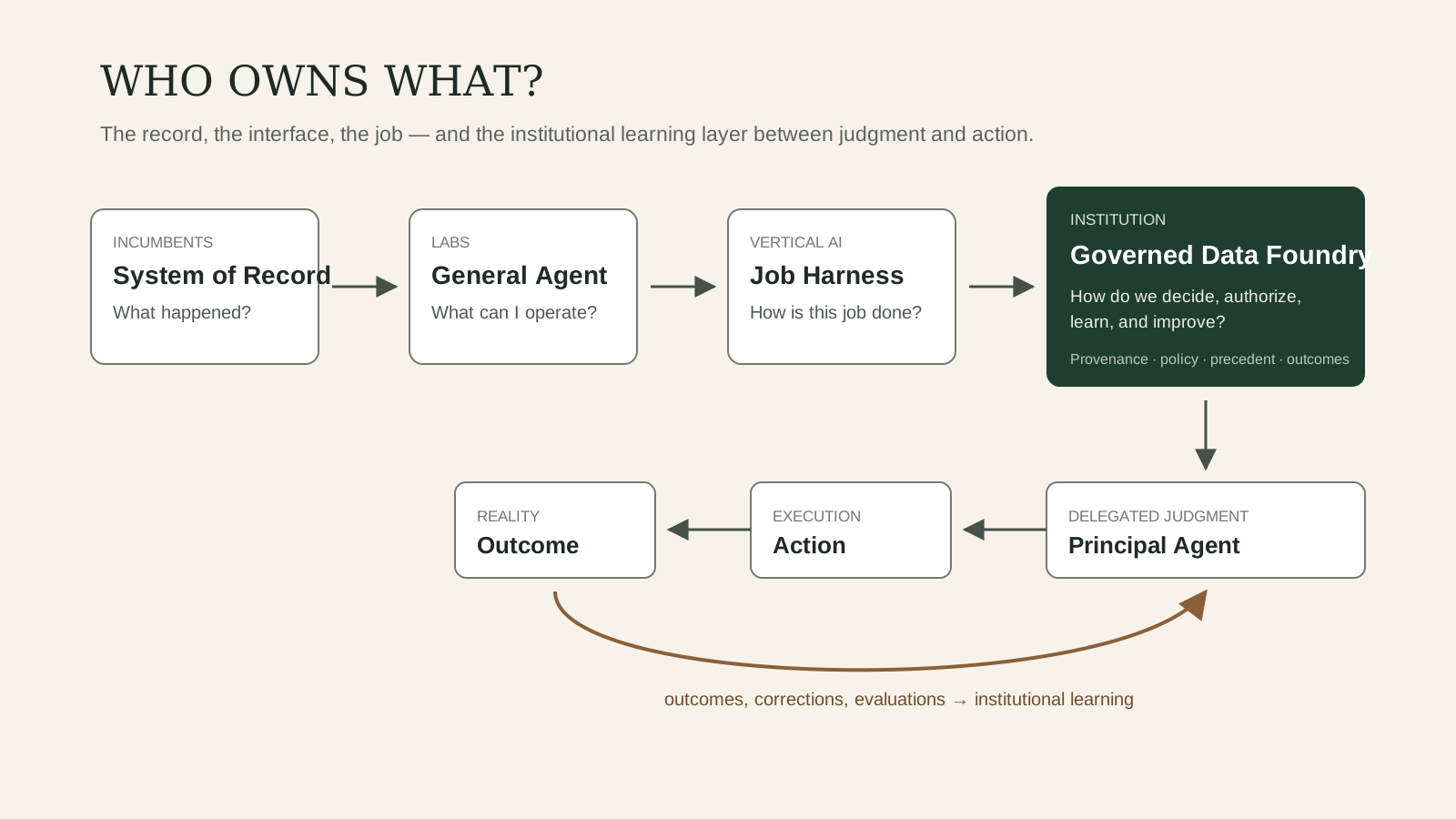
Figure 1. My mapping of the emerging ownership stack. The Foundry does not replace the record, agent, or vertical harness; it governs the institutional path from judgment to consequence and back into learning.
2. The Job Is Bigger Than the Record
The strongest part of the a16z argument is its insistence that the customer's job is bigger than any single record. A contract is not the legal matter. A ticket is not the customer resolution. An opportunity is not the sale.
That observation is more consequential than it first appears. Systems of record are necessarily local. Salesforce expands outward from the customer and opportunity record. Docusign expands outward from the agreement. Jira expands outward from the issue or project. Each can add AI, pull in external context, and automate more work, but its natural center of gravity remains the record it owns.
Real institutional work crosses those boundaries. A supplier-quality investigation, for example, may involve a defect record, manufacturing measurements, supplier documentation, contracts, equipment logs, engineering analysis, plant procedures, regulatory requirements, correspondence, expert judgment, corrective actions, and later evidence about whether the correction worked. No single record necessarily contains the work.
A general agent can traverse more of those systems, but access is not the same as comprehension. Different systems may use different identifiers and semantics for the same entity. External counterparties may own evidence the enterprise cannot simply retrieve. The same term may have several legitimate business meanings. Policy may depend on context that is not stored in any one application. And the authority to take an action may depend on an institutional instrument that is entirely separate from the system where the action lands.
This is where I see the first direct connection to the Governed Data Foundry. The Foundry was never intended to become a universal replacement for systems of record. Its ten-layer architecture explicitly begins by renting and consuming the capabilities the enterprise already has: operational systems, data and AI substrate, semantics, identity, policy, and agent protocols. Layers 1 through 3 form the Foundation zone, and for almost every enterprise that zone is an integration surface rather than a build, which is why the architecture takes Apache Ossie conformance as the acceptance test for governed meaning instead of proposing a semantic interchange format of its own. It is equally explicit about what it does not specify at all: model training, selection, and serving; agent planning, orchestration, and memory; storage, transformation, and query execution; and the identity protocols and policy languages being standardized elsewhere. Its durable problem begins where comprehension becomes consequence.
This is also why I do not interpret the rise of AI-native interfaces as a reason to weaken the Foundry. It does the opposite. The easier it becomes for intelligence to reach across applications, the more important it becomes to preserve what cannot be inferred merely from access: governing meaning, evidence state, authority lineage, releasability, reversibility, permission, enforcement, and observed outcome.
3. The Agent Hierarchy Is Also a Governance Hierarchy
The a16z article provides a useful four-level hierarchy: retrieval assistants, process agents, policy agents, and principal agents.
Retrieval assistants find and summarize information. Process agents perform bounded work under relatively explicit rules. Policy agents apply organizational playbooks, precedents, thresholds, and exceptions to ambiguous cases. Principal agents make more open-ended tradeoffs about what the organization should do.
I would preserve that hierarchy and add a second interpretation: every step upward is not only an increase in capability; it is an increase in the governance burden.
A retrieval assistant primarily needs trusted information and appropriate access. A process agent additionally needs executable permissions, workflow state, and reliable constraints. A policy agent needs governing meaning, policy state, precedent, evidence quality, exception logic, and escalation boundaries. A principal agent needs all of those plus an explicit account of institutional objectives, risk, tradeoffs, authority, accountability, and the limits of delegation.
Figure 2
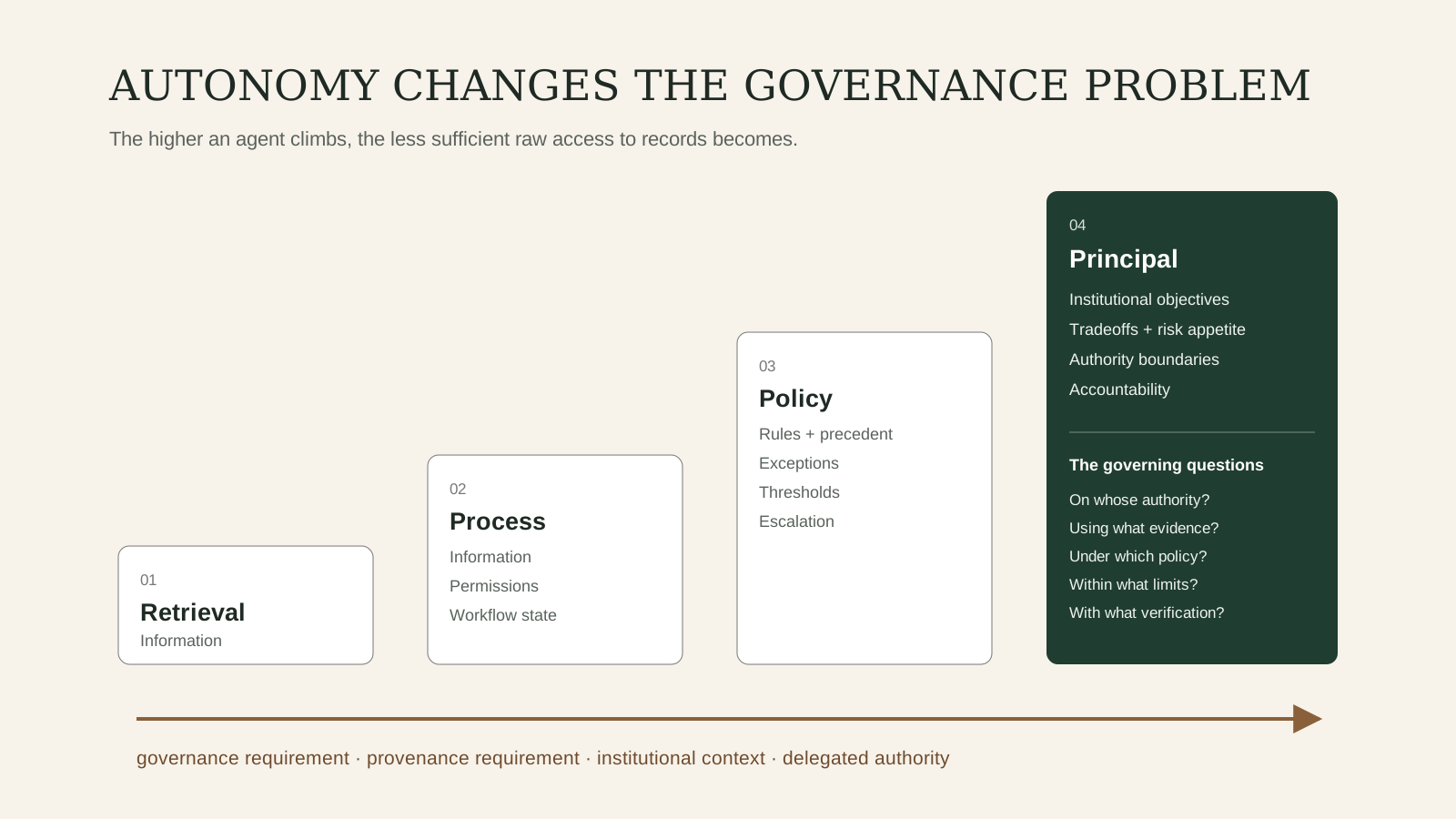
Figure 2. As agents move from retrieval toward principal-level judgment, raw system access becomes less sufficient. Provenance, institutional context, enforcement, and delegated authority become load-bearing.
This is exactly the threshold the Governed Data Foundry was designed around. The question changes from Can the model reason about this? to On whose authority, using which evidence, under which interpretation and rule state, within what limits, may this actor cause the institution to do it?
That distinction is why I continue to separate entitlement from authority. An identity system can establish which actor is present, which credentials it possesses, and which resources it can technically reach. It cannot by itself establish that the institution has legitimately delegated authority for this particular consequential decision.
The a16z hierarchy therefore lands naturally inside the Foundry rather than outside it. Retrieval and process agents may often operate with conventional access and workflow controls. Policy and principal agents increasingly cross into the upper Foundry responsibilities: institutional adjudication, evidence, authority lineage and competence, authority decisioning, non-bypassable enforcement, and outcome memory. In the architecture's own grouping, that crossing is the point where a deployment stops living in the Foundation and starts depending on Understand and Interpret, Decide and Control, and Learn and Adapt. It is also the point at which two classifications stop being descriptive and become load-bearing: the reversibility class of the action, and its releasability, meaning who holds the authority to release the constraint that would otherwise refuse it.
4. Remembering Is Not Learning
The article's distinction between remembering and learning is, for me, the most important contribution to this analysis.
General-purpose agents will have better memory. They will remember preferences, prior instructions, conversations, and facts about a customer or institution. Systems of record will continue to preserve completed state. Knowledge systems will preserve documents, definitions, and institutional knowledge. None of that automatically explains whether a piece of work was good or why an expert changed it.
A signed contract shows what the parties finally agreed. It does not preserve every clause considered, every rejected alternative, the reason an exception was accepted, the negotiating constraint that mattered most, or which party possessed the right to waive it. A closed support ticket records a resolution. It does not necessarily preserve every hypothesis tested, why one diagnostic path was abandoned, or what evidence established the root cause.
This leads me to a refinement of the Foundry vocabulary. The original architecture correctly makes the governed action record the central noun because consequential action must be reconstructible. I would not replace that object. But the a16z analysis suggests a useful larger unit around it: the governed episode.
A governed episode is the complete learning envelope surrounding one consequential piece of work. It contains the governed action record but also retains enough of the path to teach the institution something about the work itself:
context → evidence → interpretations → alternatives → policy and constraints → authority → decision → enforcement → action → resulting state → outcome → evaluation → learning disposition.
The governed action record answers: Why was this action institutionally permissible?
The governed episode adds: What should the institution learn from how this work unfolded?
I want to be precise about the relationship, because the action record is normative and the episode must not quietly relax it. Its properties stand unchanged: every consequential action traces to an accountable principal through a recorded chain, no hop in that chain grants more than it received, every delegation binds the version of the rule under which it was issued, the interpretation warrant records the rejected alternatives and the authority that may release the constraint, the evidence envelope types each claim and carries a staleness budget, and every claim carries an information state distinct from its truth value. The episode wraps that record with the surrounding path. It does not substitute for any field inside it.
That distinction prevents me from making the mistake of turning “learning” into another name for logging. A trace is not learning. A memory is not learning. Even a complete action record becomes a closed-loop asset only when later institutional standing, evidence requirements, competence, policy, or the extent of delegation actually changes because of what happened.
5. Profession, Institution, and Situation
The a16z article makes another valuable distinction between learning the profession and learning the institution.
A vertical AI company has to learn how a competent lawyer, tax professional, accountant, quality engineer, claims analyst, or security investigator performs the job. That professional competence can be taught through expert-created assignments, synthetic examples, standards, rubrics, and evaluations. It does not require waiting for years of customer history.
But a deployed system also has to learn how a particular institution performs that work: its templates, precedents, escalation rules, risk thresholds, exceptions, preferred practices, and historical interpretations. Those lessons emerge from the institution's existing material and from the corrections, overrides, exceptions, and outcomes produced in operation.
I would add a third domain: the situation.
Professional knowledge tells the system what competent work looks like in general. Institutional knowledge tells it how this enterprise chooses to operate. Situational evidence tells it why this case is different from the last one.
| Learning domain | Core question | Typical contents |
|---|---|---|
| Profession | How should good work be performed? | Methods, standards, expert rubrics, canonical tasks, evaluation criteria |
| Institution | How do we perform and govern this work? | Policy, precedent, risk appetite, delegation, escalation, templates, prior exceptions |
| Situation | What is true and material in this case now? | Current evidence, counterparties, temporal state, uncertainty, external constraints |
Agentic judgment therefore becomes a composition of professional competence × institutional character × situational evidence.
The Foundry is primarily concerned with the second and third terms at the point of consequence. It can consume professional curriculum from a vertical harness, but it must bind that capability to the institution's current semantics, authority, constraints, evidence, and enforcement state.
This is fully consistent with the portable competence assertion in the original Foundry architecture, and with the principle underneath it: intelligence federates upward, while authority stays local. A foreign institution may attest to what an agent has demonstrated. The receiving institution evaluates that evidence. It does not inherit the sender's authority merely because the competence traveled. The assertion is also scoped rather than global, since the Agent Earned Authority Score is bound to a task class and a context band, and an agent that has demonstrated excellence in one context band has demonstrated nothing whatsoever in another.
6. Harvey and the Manufactured Curriculum
The Harvey example in the a16z article adds an important implementation lesson. A vertical AI company does not have to wait passively for a vast stock of historical customer data before it can become competent at the profession. It can manufacture a curriculum using synthetic cases, public material, expert-authored assignments, tools, and detailed rubrics.
That idea belongs naturally beside the Foundry's outcome-memory architecture, but the two should not be confused.
The vertical harness can manufacture professional learning environments before deployment. The Foundry accumulates institution-specific evidence from governed operation. One teaches the system the profession; the other preserves what this institution learned when that professional capability encountered its own policies, authority, constraints, and consequences.
This suggests five classes of learning material that can coexist around the Foundry:
| Episode class | Purpose |
|---|---|
| Historical | Preserve real decisions, authority state, actions, and observed outcomes |
| Synthetic | Teach professional capability before sufficient production history exists |
| Counterfactual | Test how a decision changes when evidence, policy, or thresholds change |
| Boundary | Exercise authority ceilings, exceptions, releasability, and escalation conditions |
| Canonical | Preserve gold-standard examples of how the institution expects a recurring class of work to be handled |
The architectural discipline is to keep their standing distinct. A synthetic exercise can demonstrate competence. It does not prove that a real-world fact existed. A historical outcome can inform a later delegation. It does not retroactively make the earlier decision legitimate. A canonical example can guide policy interpretation. It does not replace the policy or authority instrument itself.
That separation is exactly the kind of epistemic discipline the Foundry already requires. The mechanism for holding it is already in the architecture, because the evidence envelope types every claim as evidence or testimony and records an information state distinct from its truth value. A synthetic episode therefore enters as testimony about competence, never as evidence that a fact obtained.
7. Mapping the a16z Stack into the Governed Data Foundry
The most useful way for me to integrate the article is not to add another parallel architecture. It is to map each of its actors into the ten responsibilities of the existing Foundry.
Figure 3
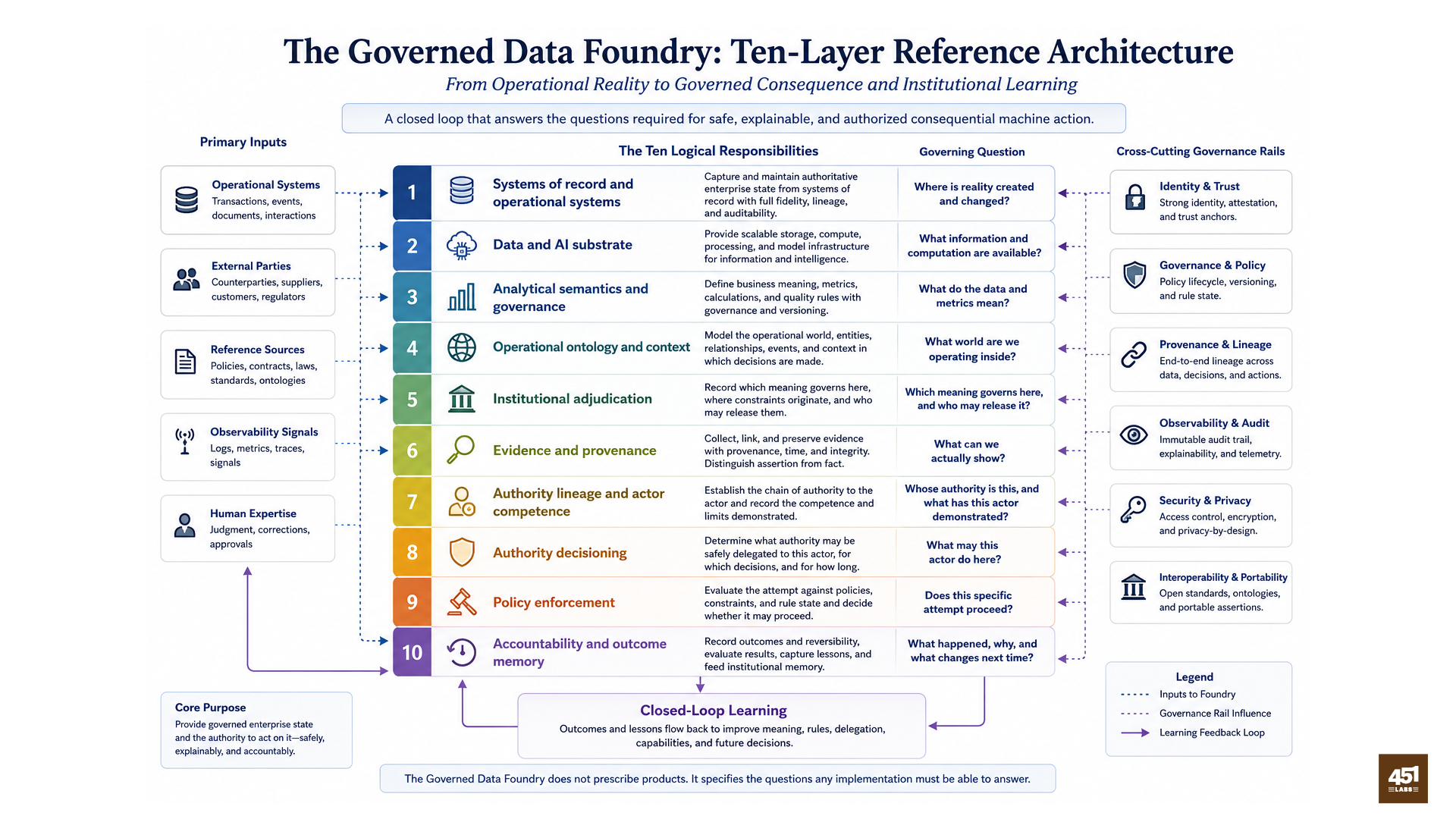
Figure 3. The ten responsibilities and the four zones. Implementations may consolidate several of them into one product, but an implementation that cannot say which component answers which question does not conform.
The system of record remains Layer 1: where operational reality is created and changed. Data platforms remain Layers 2 and 3: information, computation, semantics, lineage, and governed meaning. A vertical AI harness will often contribute heavily to Layer 4 because it assembles job-specific operational context, tools, professional curriculum, and workflow. A general agent may interact with all of those layers, but it should not own the institutional authority path simply because it is the interface.
The durable Foundry responsibilities begin to dominate as the job becomes consequential: Layer 5 determines which legitimate meaning governs; Layer 6 preserves evidence and provenance; Layer 7 establishes authority lineage and what the actor has demonstrated; Layer 8 decides what this actor may do here; Layer 9 enforces whether this attempt proceeds; Layer 10 retains what happened and feeds observed consequence back into later standing, evidence, competence, and delegation.
One detail of the control flow deserves emphasis here, because it is exactly where the a16z picture of agents working through Salesforce, SAP, and ServiceNow meets the architecture. Enforcement does not route into the system of record. Layer 9 permits or refuses, and a separately credentialed effector performs the write under a signed execution grant carrying an idempotency key issued at decision time. If the enforcement point can itself write, it is not a brake, and if the agent holds the credential, there was never a boundary to begin with. What lands in the incumbent's system is therefore not the agent's action; it is an effector executing a permitted verdict, which is the only version of the event that can be reconstructed afterward.
Figure 4
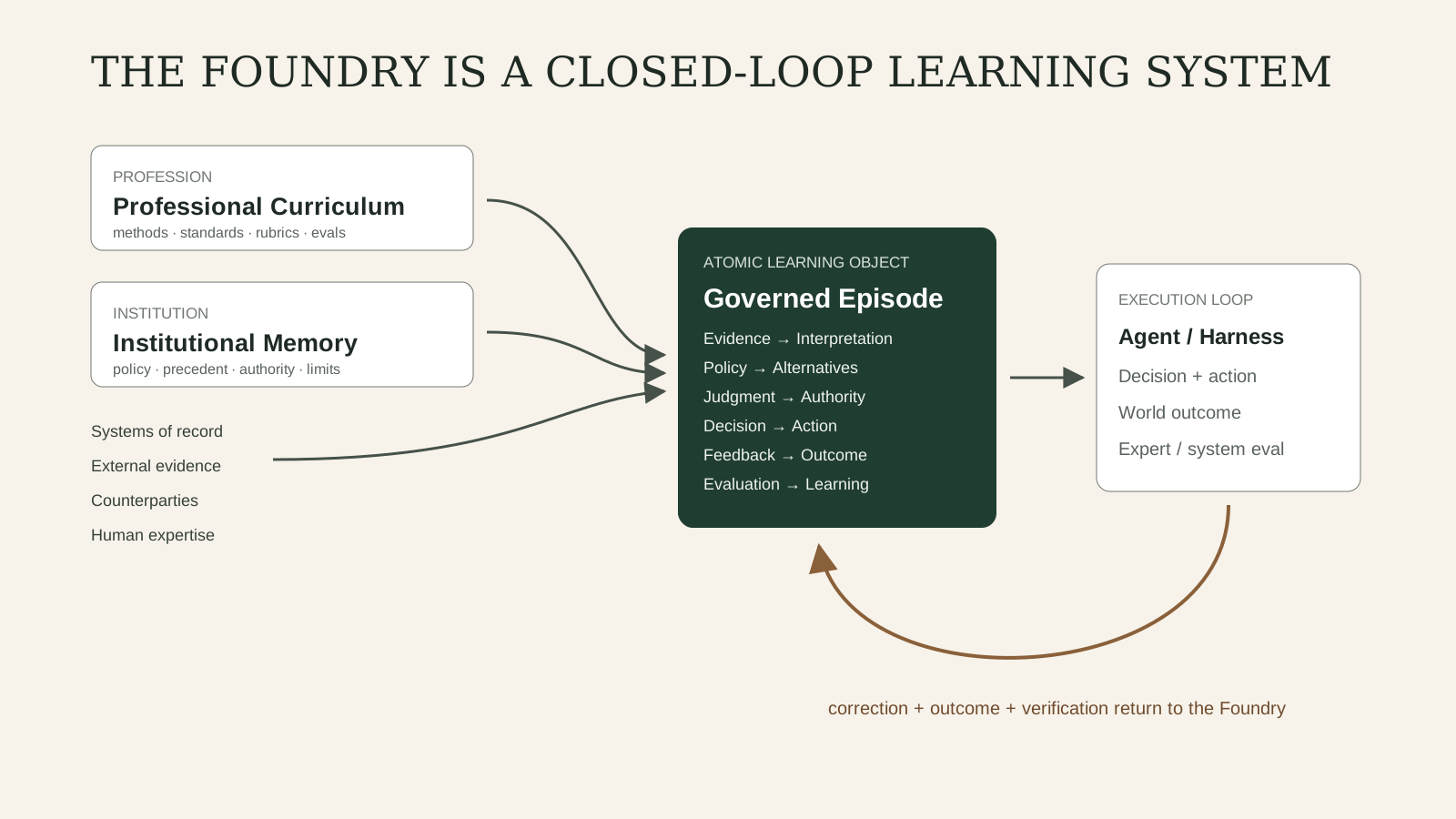
Figure 4. Professional curriculum and operational context enter the decision path, but institutional learning closes only when outcomes return through evidence, competence, standing, and the continuing validity of delegation.
This mapping makes one point especially clear: the general agent is an actor in the architecture, not the architecture itself.
The same is true of the vertical harness. It may become exceptionally good at performing the job. It may own professional curriculum, specialized tools, and expert evaluations. But when it causes real institutional state to change, it still needs an authority origin, current rule state, evidence envelope, permission decision, enforcement boundary, and independent observation of outcome.
That boundary preserves the division of labor I want the architecture to make explicit. The vertical harness can improve how the job is performed; the Foundry remains responsible for establishing when that capability may cross from recommendation into consequential institutional action.
8. From System of Record to System of Learning
This analysis also gives me a cleaner way to distinguish the successive systems enterprises are assembling.
A system of record preserves authoritative operational state.
A system of work organizes the workflow through which people and software move that state.
A system of judgment helps determine what should happen under ambiguous conditions.
A system of learning preserves whether those judgments were well founded, legitimately authorized, correctly executed, and borne out by reality, and uses that evidence to change later decisions.
The vertical AI company described by a16z wants to move from system of work toward system of judgment. That is a powerful position. My argument is that the durable institutional infrastructure surrounding it must continue one step further into the system of learning.
This is where the Foundry becomes more than a governance wrapper around agents. Its outcome memory is not a compliance archive. It is the compounding record from which the institution can determine whether a standing delegation remains defensible, whether an agent's competence has changed, whether a precedent should retain standing, whether a policy boundary is producing the intended result, and whether a previously acceptable interpretation should be reconsidered.
That is also why one claim in the implementation sequence is normative rather than advisory: among the durable core, Layer 10 is built first, because accountability is a present legal requirement while earned autonomy remains a thesis. Outcome memory has value while humans still approve the action. It has value under bounded automation. And it becomes indispensable if the institution later grants standing machine delegation. The evidence required to make that transition responsibly cannot be reconstructed after the fact, which is also why the phase that makes authority explicit has explicit authority, not autonomy, as its objective.
9. Earned Delegation Becomes More Concrete
The a16z hierarchy makes my earlier concept of earned authority more concrete, but it also reinforces a correction already made in the Governed Data Foundry architecture: evidence does not originate authority.
An agent can demonstrate that it is excellent at contract review, supplier investigation, tax analysis, security triage, or procurement approval. It can accumulate a strong outcome history. It can outperform people on a defined evaluation. None of that creates an institutional right to bind the enterprise.
Authority originates with an accountable principal and an institutional instrument capable of legitimately delegating some portion of that authority. Evidence and competence determine how much of that existing authority the principal may responsibly choose to delegate, for which task class, under which context, for what duration, subject to which exclusions and obligations.
Two mechanisms keep that from being a statement of intent. Every consequential action traces to an accountable principal through a recorded chain, and no hop in that chain grants more than it received, with attenuation checked at decision time rather than audited afterward, because a silently expanded grant is indistinguishable from a valid one once the action has landed. And every delegation binds the version of the rule under which it was issued, so that when the governing policy changes, the delegation is visibly resting on a basis that no longer exists.
The progression therefore looks like this:
capability → evaluated episodes → demonstrated competence → principal decision → bounded delegation → governed action → independent outcome → updated evidence → delegation retained, narrowed, expired, or re-derived.
This is a much stronger model than “the agent becomes autonomous as the model gets better.” It makes autonomy an institutional state transition rather than a product feature.
That insight may be one of the most useful consequences of combining the a16z hierarchy with the Foundry. The four agent classes are not only product categories. They are candidate delegation classes, each requiring progressively stronger evidence and institutional machinery.
10. What the Foundry Must Not Become
The a16z essay also helps sharpen the negative space around the Foundry.
It should not become a new CRM, ERP, data lake, semantic warehouse, identity provider, general agent, or vertical workflow platform merely because it touches all of them. The original architecture is correct to consume those capabilities rather than territorialize the entire stack.
It should not confuse memory with learning. Storing every trace from every agent would create an expensive archive without necessarily creating better institutional judgment.
It should not confuse professional curriculum with institutional authority. A highly trained vertical model still acts under local institutional constraints.
It should not let the agent own the enforcement path. A model that interprets its own authority and also holds the write credential collapses rule-taker, decider, and effector into the same failure domain, which is the one configuration the architecture's own verdict rule answers with Stop. The decision point decides, the enforcement point enforces, and the effector alone writes. Of every item in the conformance checklist, non-bypass is the one whose failure invalidates all the others, because a system that can be routed around still produces a record, and that record will look complete.
And it should not turn outcome history into a shadow constitution. Good performance can justify a broader grant. It cannot manufacture a grant the institution never issued.
These boundaries preserve the original Foundry thesis rather than expanding it opportunistically around every new AI development.
11. The Strategic White Space
The a16z article frames the market around an increasingly clear contest.
Incumbents are moving from recordkeeping toward action. General-purpose agents are moving toward becoming the cross-application front door. Vertical AI companies are moving from retrieval toward ownership of an entire job. All three trajectories are credible.
The white space I see sits across rather than beneath them: institution-specific governed learning and delegated judgment.
That territory is difficult for the incumbent because the full job crosses beyond its local record. It is difficult for the general agent because broad access does not automatically supply professional depth, institutional precedent, local authority, or outcome-grounded evals. It is difficult for a vertical harness because job expertise alone does not give it the institutional right to act.
The Foundry composes those worlds at the point of consequence.
Its defensible asset is therefore not “more context.” Context will become plentiful. It is not “memory.” General agents will have memory. It is not even “policy.” Policy engines already exist.
The compounding asset is the governed institutional record of judgment: what meaning governed, what evidence existed, which alternatives were available, whose authority was exercised, how far that authority legitimately extended, what enforcement occurred, what reality became afterward, and what that outcome changed for the next decision. Three properties of that record are hard for any of the three trajectories to produce as a byproduct of what they already do well: it preserves the difference between what was false and what could not be established, it binds authority thresholds to reversibility and releasability rather than to consequence magnitude alone, and it makes the competence record portable across an organizational boundary, which no platform-internal authority model can do.
This also makes the commercial sequencing clearer. The first Foundry product need not promise principal agents. It can begin by making consequential human-and-agent decisions reconstructible, preserving outcome memory, and making existing delegation explicit. The learning asset compounds before the enterprise accepts broad autonomy.
12. The Revised Proposition
After reading the a16z argument through the Foundry, I would now state the proposition more precisely.
The AI enterprise does not need another universal system of record. It needs a governed system that can reconstruct how records became evidence, how evidence was interpreted, whose authority made a judgment legitimate, how that judgment crossed an enforceable boundary into action, what state changed, and what the observed outcome should change next time.
Reconstruction there is a specific requirement rather than a rhetorical one. It means producing, for any governed action, the governing interpretation warrant with its rejected alternatives, the evidence envelope as asserted at decision time, the actor's competence for that task class and context band, the delegation contracts, the policy version evaluated, the verdict with its conditions and any unresolved predicates, the enforcement outcome, the effector and idempotency key, the reversibility class and compensation handle, the resulting state change, and the observed outcome. It also means reconstructing from the state available at decision time rather than from current state, because a decision replayed against today's data is not a reconstruction of anything.
That system is not a substitute for Salesforce, SAP, Docusign, Jira, Claude, Codex, or a specialized vertical harness. It is the institutional control and learning architecture in which those systems can participate without silently converting access, comprehension, model capability, or platform permission into authority.
The a16z argument therefore does not undermine the Governed Data Foundry by restoring strategic importance to systems of record. It clarifies the division of labor.
The incumbent owns the record.
The general agent may own the front door.
The vertical AI company may own the job-specific harness and professional learning loop.
The institution must still own the legitimacy of its judgment, the lineage of its delegated authority, and the memory of consequence.
That last responsibility is the Governed Data Foundry.
13. What This Analysis Changes in the Foundry
I would make four refinements to the Governed Data Foundry as a result of this analysis without changing its ten-layer spine.
First, I would make the distinction between governed action record and governed episode explicit. The action record remains the normative reconstruction artifact for consequential action. The episode is the larger learning envelope that connects multiple observations, alternatives, corrections, and outcomes around a piece of work.
Second, I would make professional curriculum an explicit external input to the architecture. A vertical harness may train and evaluate professional competence through synthetic and expert-created tasks. The Foundry should consume evidence of that competence rather than recreate the curriculum itself, which is consistent with an architecture that already declines to specify model training, agent orchestration, and query execution.
Third, I would explicitly map the a16z agent hierarchy to delegation classes. Retrieval, process, policy, and principal agents require progressively stronger evidence, authority lineage, enforcement, and outcome review. That gives institutions a clearer path for moving from assistance toward bounded autonomy without treating autonomy as binary.
Fourth, on institutional learning closure, I should be accurate about what is already there. Closure is not a refinement I am adding. The architecture already carries it as a conformance requirement, holding that outcomes recorded at Layer 10 must demonstrably alter subsequent Layer 5, 6, and 7 state, and that an implementation whose outcome record has no downstream consumer has built a log rather than an architecture. What this analysis adds is one entry to that list of consumers. Alongside changed evidence standards, changed competence, and changed standing, an accountable principal re-deriving the extent of an existing delegation should count as closure, because in practice that is the consumer an institution will exercise first.
None of those changes alter the ten-layer spine, the invariants, or the conformance checklist. They make the architecture's strategic purpose easier to see in a market where record ownership, interface ownership, and job ownership are increasingly separating.
14. Conclusion
The emerging AI application stack is not collapsing into one winner.
Systems of record remain important because they hold authoritative state and executable actions. General agents can increasingly sit above them and become the interaction layer across many systems. Vertical AI companies can still create durable value by becoming exceptionally good at a particular job, manufacturing professional curriculum, accumulating expert corrections, and building a faster learning loop around repeated work.
I accept all three propositions.
The Governed Data Foundry begins where they intersect.
When the work becomes consequential, someone still has to determine which institutional meaning governs, what evidence is admissible, whose authority is being exercised, whether the relevant constraint may be released, how far the delegation extends, whether the action is reversible, which attempt is permitted, whether enforcement can be bypassed, what state actually changed, and what the institution should learn from the result.
That is not merely a data problem. It is not merely an agent problem. And it is not merely a vertical workflow problem.
It is the problem of making institutional judgment computationally legible, enforceable, reconstructible, and capable of learning from consequence.
The important shift is therefore not from applications to agents. It is from institutions that mainly preserve operational state to institutions that can also preserve and improve the governed path by which they decide what should happen next.
The job may still be up for grabs, but the institution's authority should not be. That is the line I would preserve as agents, vertical harnesses, and incumbent systems converge: capability may be distributed across the stack, while legitimacy, delegated authority, and learning from consequence remain an institutional responsibility.
A Note on AI-Assisted Research and Intelligence Provenance
This journal is my analysis of the a16z essay supplied for review and its implications for the Governed Data Foundry architecture. AI assistance was used to support synthesis, architectural comparison, and figure production. The analytical judgments, architectural distinctions, and conclusions are mine. The underlying Governed Data Foundry concepts referenced here, including governed enterprise state, authority lineage, interpretation warrants, reversibility, releasability, non-bypassable enforcement, portable competence, and outcome memory, follow the reference architecture developed separately in The Governed Data Foundry, v3.5.
References
Amble, S. (2026). The incumbents are coming. Andreessen Horowitz. https://www.a16z.news/p/the-incumbents-are-coming
Reddy, S. (2026a). The Governed Data Foundry: A reference architecture for governed enterprise state in the agentic era (Reference Architecture v3.5). Musewoods Journal.
Reddy, S. (2026b). The Authority Layer: Why the next enterprise AI infrastructure category is governed permission, not shared meaning. 451 Ventures.
Reddy, S. (2026c). The Convergent Enterprise: AI, enforceable delegation, and the end of management latency. 451 Degrees standing thesis.
Reddy, S. (2026d). Earned authority: Agent competency intelligence and the Agent Earned Authority Score. SSRN Abstract 7268001.