Architecture
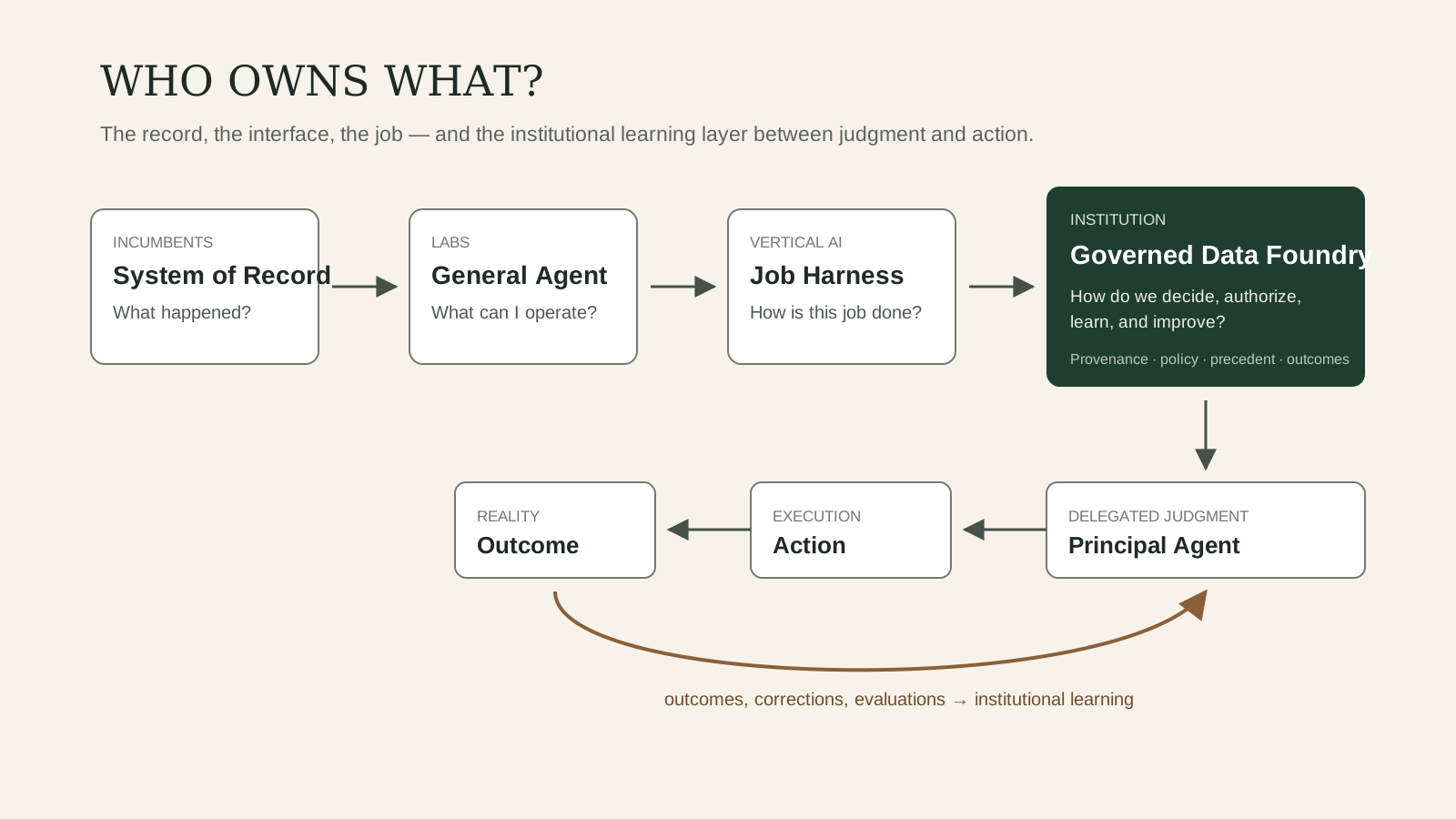
Ten layers, four zones, one closed loop.
The Foundry does not propose ten new products. It specifies ten questions that any implementation governing consequential machine action must be able to answer — several of which a single platform may already answer today. Layers 1 through 3 sit on infrastructure the market has spent three decades building; the architecture treats them as an integration surface, not a greenfield build.
The Ten Layers
| Layer | Responsibility | Governing question | Zone |
|---|---|---|---|
| 1 | Systems of record and operational systems | Where is reality created and changed? | Foundation |
| 2 | Data and AI substrate | What information and computation are available? | Foundation |
| 3 | Analytical semantics and governance | What do the data and metrics mean? | Foundation |
| 4 | Operational ontology and context | What world are we operating inside? | Understand and Interpret |
| 5 | Institutional adjudication | Which meaning governs here? | Understand and Interpret |
| 6 | Evidence and provenance | What can we actually show? | Decide and Control |
| 7 | Authority lineage and actor competence | What has this actor demonstrated, and on whose behalf? | Decide and Control |
| 8 | Authority decisioning | What may this actor do here? | Decide and Control |
| 9 | Policy enforcement | Does this specific attempt proceed? | Decide and Control |
| 10 | Accountability and outcome memory | What happened, why, and what changes next time? | Learn and Adapt |
Layer 10 is the only layer whose output is another layer's input rather than an action: it closes the loop by returning consequence back into evidence, competence, and standing, rather than terminating in an archive.