The Field Is the Join
A Regenerative Supply Network for Land, Food, Evidence, and Markets
Agriculture has become extraordinarily capable of moving food while remaining remarkably poor at preserving the context that created it. Once a crop leaves the farm, a living production system is progressively reduced to commodity, grade, quantity, lot, price, certification, and destination. The simplification is commercially useful, but it also severs relationships that become essential when a buyer wants to understand regenerative production.
This Grove begins from a different premise. A carrot is not regenerative by itself, and a farm does not become regenerative because a database says so. Regeneration is expressed through the management of land over time: soil disturbance and protection, crop rotations, living roots, nutrient and water management, livestock integration where appropriate, habitat relationships, farmer decisions, economics, evidence, and the ecological systems within which those decisions occur.
The Governing Proposition
Agricultural provenance should begin with the land, preserve the production history of that land, and carry the relevant context forward with the food. The field or management unit is the critical join because it belongs simultaneously to two worlds. It sits inside soils, watersheds, aquifers, terrain, climate, habitat, and neighboring landscapes, while also participating in crop plans, management events, harvests, production lots, shipments, contracts, and buyer demand.
Once that join remains computationally intact, traceability changes character. The question is no longer merely whether a shipment can be traced to a supplier. The system can begin to explain which land produced it, what happened there, what evidence supports the record, how that land is changing, which landscape systems it depends upon, and how the market transaction can influence future production.
The Shape of the Grove
Land
Farm, parcel, field, and management zone are distinct spatial objects. Field geometry has history, and every field participates in multiple overlapping ecological systems.
Twin
The Regenerative Twin connects land, ecology, management, production, outcomes, and economics across time. It turns fragmented farm knowledge into a producer-controlled computational asset.
Provenance
Harvested food must retain its relationship to the field, production cycle, practices, evidence, and transformations that created it, even when lots are divided or aggregated.
Trust
Practice, evidence, outcome, and claim are different objects. The system must know whether something was declared, observed, verified, modeled, inferred, or remains unknown.
Markets
Buyers should be able to express procurement intent before harvest, allowing the network to identify suitable farms, fields, production windows, practices, evidence requirements, and economics.
Landscapes
Property lines organize ownership; watersheds and aquifers organize ecological dependency. Procurement can therefore become a landscape strategy as well as a supplier strategy.
Intelligence
Specialized agents translate fragmented records, buyer requirements, geospatial context, evidence, and production options without becoming the authoritative source of truth.
Build
The network begins with field identity, production cycles, harvest lots, and buyers. Landscape intelligence, evidence, market-making, watershed coordination, and collective learning grow around that spine.
The Field as Join
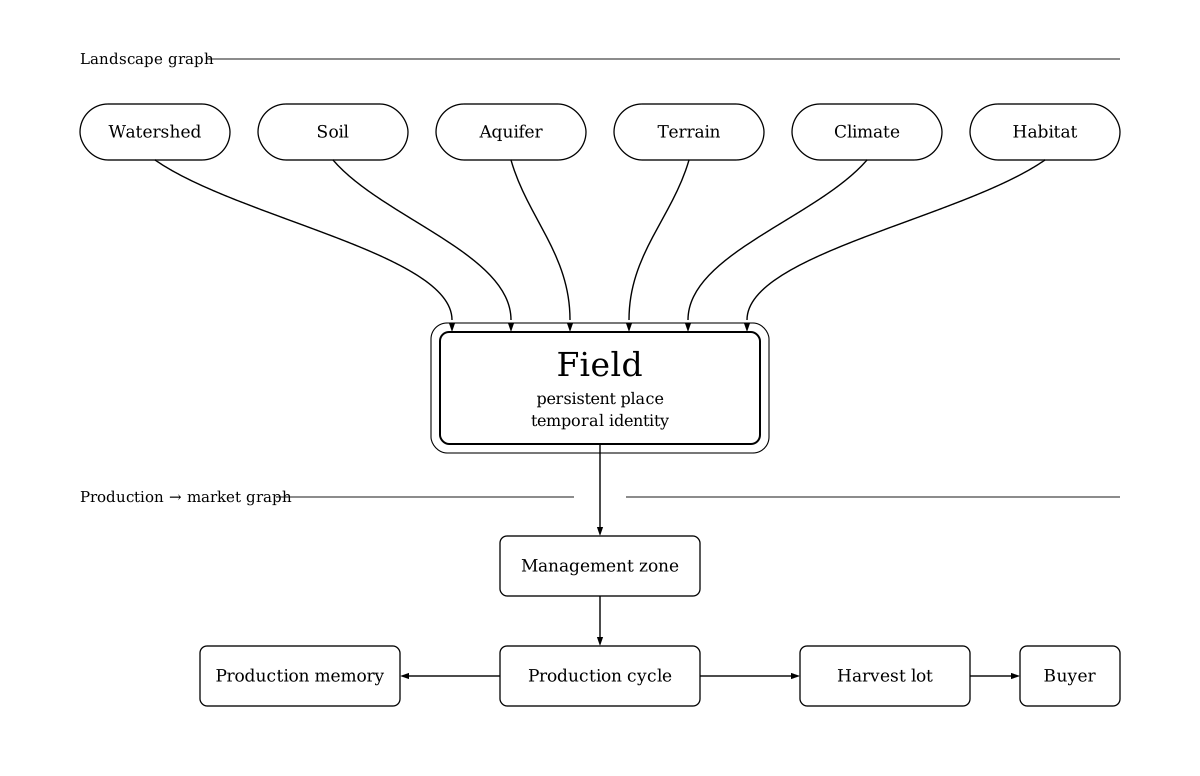
The diagram is intentionally simple. The system is not organized around the product catalog. It is organized around the persistent relationship between agricultural place and commercial output.
What This Changes
A conventional regenerative marketplace typically begins with producers and products. The farmer creates a profile, the product receives attributes or certifications, and the buyer searches for inventory. That approach can make commerce easier, but it still treats the farm mainly as a supplier and regeneration mainly as a property of what is being sold.
The Regenerative Supply Network begins earlier. Land has identity before a crop is planted. A field has a history before a buyer appears. A production cycle can be represented before harvest. Evidence can accumulate as agricultural events occur. Buyer demand can be expressed before acreage is committed. The resulting system is therefore capable not only of describing past production but of helping coordinate future production.
The deeper opportunity is cumulative learning. Every growing season contains thousands of distributed experiments in rotation, tillage, irrigation, nutrients, grazing, varieties, planting dates, harvest timing, and risk. Most of that experience disappears into individual memory and disconnected systems. If the network can preserve what happened, where it happened, under what conditions, with what economic consequences and evidence, agriculture can begin to learn from itself without erasing the local context that makes those experiences meaningful.