
Authoring Grammar
Musewoods authoring starts with ordinary Markdown structure and a small amount of explicit field grammar. A ## heading establishes a section, ### creates a nested block, and #### creates an item where the active motif expects one. Recognized **Key:** value fields are consumed by the motif or field model; unsupported render names and structurally impossible shapes fail validation rather than being silently ignored. Where the grammar permits inference, Musewoods may resolve a motif from authored shape so authors do not have to repeat presentation metadata that the structure already makes obvious.
The governing idea is semantic reuse. A motif names an editorial, analytical, or navigational responsibility — framing a proposition, carrying evidence, showing sequence, comparing alternatives, or opening controlled interaction — rather than the page that first happened to need that treatment. This keeps the vocabulary portable and makes renderer changes possible without rewriting content around page-specific CSS.
Vertical rhythm follows the same rule. Authors create paragraph boundaries with ordinary Markdown blank lines; they do not add empty paragraphs, <br>, or spacer content to control layout. The renderer and CSS own paragraph spacing, object spacing, and motif transitions, and those are different responsibilities rather than one universal gap.
This page is a decision guide and specimen map, not a substitute for the machine-generated vocabulary reference. The exhaustive Story contract remains docs/storyboard-vocabulary.md, generated from the registry by npm run docs:vocabulary. The grouped sections below explain why motif families exist, show representative live specimens, and keep the remaining reference forms close enough to the production examples that an author can move from intent to valid source without guessing.
The Motif Families
Structure & Framing
Shapes an argument can sit inside: a two-column callout, a framed exhibit, a panel, or subordinate context in the margin.
- Bounded editorial structures
Narrative Openers & Voice
Patterns for beginning a movement, establishing tone, and lifting language out of running prose without fragmenting the narrative.
- Openings, emphasis, and voice
Editorial Argument
Structured argumentative moves such as summary maps, proof surfaces, comparisons, sequences, and compact figures.
- Claims, evidence, and comparison
Long-Form & Reference Collections
Patterns for essays, channels, references, rosters, timelines, ledgers, and other repeated material whose order and labeling matter.
- Repeated reference structures
Navigation & Interaction
Patterns where a reader's selection changes the visible interpretation or provides a bounded next step without turning the page into an application.
- Deliberate reader-controlled state
Shared Cross-Field Motifs
Editorial and analytical contracts implemented once and hosted by Stories, Journals, and Groves without forking their behavior.
- Shared semantics, field-native voice
Structure & Framing — Live
Purpose
A two-column composition — prose in the wide column, a short nested block in the narrow one.
Authoring
### Two Voices
**Render:** callout
**Treatment:** editorial-callout
**Title:** A callout places an argument beside its terms.
A callout is a two-column composition.

#### Terms
**Render:** chips
Signal · Pattern · Evidence
Live Result
A callout places an argument beside its terms.
A callout is a two-column composition: prose in the wider column, a short nested block — most often chips — in the narrower one.
Signal · Pattern · Evidence
Contract & Implementation
`**Treatment:** takeaway` is only valid on `callout`; otherwise unconstrained.
lib/render/motifs.mjscomponents/render/Motifs.tsx
Structure & Framing — Reference
The rest of this family
A section rendered inside another act, separated by a rule rather than a new full-bleed ground.
## A Note On Method
**Render:** interlude
**Within:** narrative

### Aside Head
**Render:** subhead
**Title:** Why the spine is validated one-to-one.An editorial frame around one sourced analytical motif, referenced by `**Source:**` rather than duplicated.
### Figure 1
**Render:** exhibit
**Title:** Framed comparison
**Source:** comparison-source
**Caption:** Exposure by governance surface.Bounded editorial prose for one proposition that should read as an intact unit — no list, no fragmentation.
### One Proposition
**Render:** frame
A frame is bounded editorial prose for a single proposition.The act's main statement: a label, a title, a premise, and prose, allowed to be the most prominent thing on the page.
### The Weight
**Render:** panel
**Label:** The turn
**Title:** A panel carries the weight of its act.
**Premise:** Where an aside is quiet, a panel is the statement.A ruled mini-argument beside the main column — a label, a title, a line or two, never the weight of the act.
### Aside
**Render:** aside
**Label:** Why this matters
**Title:** Shape inference keeps the Markdown quiet.Subordinate context anchored in source order, placed in the margin on wide screens and inline on narrow ones.
### The Systems Layer
**Render:** sidecar
**Side:** right
**Title:** Sidecars ride alongside their paragraph.A compact continuation to one deeper place — a label, a title, a link, and a short note.
### Onward
**Render:** explore
**Label:** Keep reading
**Title:** Editorial is next
**Href:** #editorial
Narrative Openers & Voice — Live
Purpose
Lifts one phrase out of the running prose for emphasis, sharing the same type scale as `thesis`.
Authoring
> A pull-quote lifts one phrase out of the prose for emphasis.Live Result
A pull-quote lifts one phrase out of the prose for emphasis, using the shared quote type scale.
Contract & Implementation
A single blockquote; no required fields.
lib/render/motifs.mjscomponents/render/Motifs.tsx
Narrative Openers & Voice — Reference
The rest of this family
The universal fallback: any section falls to it when nothing tells the renderer a more specific shape.
### Generic Block
**Render:** block
**Title:** A universal block still displays fields and body copy.The standfirst opener — a claim, a working question, and a lede paragraph.
## Standfirst
**Render:** brief
**Claim:** Stories tell.
**Question:** What does a Story motif look like when the real renderer draws it?The Story's H1 opener — overline, headline, deck, and a read-on link.
## Opening
**Render:** cover
**Overline:** Field Manual
**Headline:** One vocabulary, drawn by shapeA top-level act: anchored, full-bleed ground, holds its own blocks and any interludes.
## Narrative
**Render:** chapter
**Anchor:** narrativeOpens an act with a movement number, a kicker, a title, and a deck.
### Head
**Render:** title-block
**Number:** 01
**Kicker:** Narrative motifs
**Title:** The Story sets a scene and holds a line.The same parts as title-block, one register down, for an interlude or a nested act.
### Sub
**Render:** subhead
**Number:** 2.1
**Title:** A subhead opens a section one level down.Ordinary body copy at reading measure — the default shape a section falls to when it carries paragraphs alone.
### Body
**Render:** prose
Body copy sits at reading measure.The opening paragraph of an act, with a drop cap — the same job as `lead`, one register more formal.
### Intro
**Render:** lede
The opening paragraph of an act can take a drop cap.Sets opening prose large without the drop cap, for an act that begins mid-thought.
### Second Voice
**Render:** lead
A lead sets its opening prose large without the drop cap.A compact inline sequence of terms, set apart by a rule.
### Keyline
**Render:** keyline
Signal · Pattern · Evidence · ProvenanceA ruled quote shell — the same type scale as `pull-quote`, given a rule and more gravity.
### Declared
**Render:** thesis
> A thesis is a ruled quote shell.
Editorial Argument — Live
Purpose
An executive argument map — two to eight titled moves, each with an optional number and note. Never navigation.
Authoring
### Argument Map
**Render:** summary
**Title:** Three moves
A summary is an executive argument map.

#### 01
**Title:** State the signal
**Note:** What should the reader notice first.
Live Result
Three moves
A summary is an executive argument map: two to eight titled moves, each with optional number and note. It is never navigation.
State the signal
What should the reader notice first.
Show the pattern
Where the structure is.
Make it inspectable
The evidence a reader can check.
Contract & Implementation
2–8 items; each item needs a title.
lib/render/motifs.mjscomponents/render/Motifs.tsx
Editorial Argument — Reference
The rest of this family
A claim paired with concrete evidence — value, label, context, and credit.
### One Proof
**Render:** evidence
**Value:** 100%
**Label:** of specimens on this page rendered by the production pipelineAn editorial comparison across 2–4 declared columns.
### Comparison
**Render:** analysis-grid
**Columns:** Story | Grove

#### Voice
**Title:** Voice
**Story:** First person, narrative.
**Grove:** Institutional, place-making.A ruled row of a short title and one line about it, repeated.
### Notes
**Render:** note-list

#### First
**Title:** Title plus explanation
**Note:** A ruled row of a short title and a line about it.A row of figures — a value and a label per item.
### Figures
**Render:** stat-band

#### Motifs
**Value:** 51
**Label:** public Story motifsPeer objects — a bounded set of equal-weight ideas, distinct from a sidecar's subordinate context.
### Two Ideas
**Render:** editorial-cards

#### Signal
**Label:** First move
**Title:** Tell the reader what to noticeAn ordered conceptual progression, one step per item.
### Steps
**Render:** sequence

#### 01
**Number:** 01
**Title:** Author writes MarkdownA portable Musewoods Chart as a narrative exhibit — the shared D3 engine at a Story safe area.
### Trend
**Render:** chart
**Chart:** diverging-bar
**Title:** Delegated authority, by actor
Long-Form & Reference Collections — Live
Purpose
Long-form entries: number, label, title, premise, body, and a closing question — one entry at a time.
Authoring
### Essay Set
**Render:** essays

#### 01
**Number:** 01
**Title:** Long-form entries carry their own premise and question.
**Premise:** essays is for reasoning that needs room.
**Question:** When does a note need to become an essay?
Live Result
Essay
01
Long-form entries carry their own premise and question.
essays is for reasoning that needs room — a title, a premise, body prose, and a closing question.
QuestionWhen does a note need to become an essay?
An essays collection is the motif for that longer form, one entry at a time.
Contract & Implementation
Each item needs at least a title; premise and question are optional.
lib/render/motifs.mjscomponents/render/Motifs.tsx
Long-Form & Reference Collections — Reference
The rest of this family
Ruled entries for outward publication — the only motif Living Content latest-link enrichment attaches to.
### Channels
**Render:** channels

#### Newsletter
**Name:** The dispatch
**Href:** https://example.com/feedNumbered references — an unclamped title link over a muted metadata line.
### References
**Render:** bibliography

#### 01
**Title:** Musewoods Platform Design Specification
**Href:** /docs/musewoods-platform-design-specification
**Meta:** Internal · currentA ruled, numbered register — quieter than roster, keyed by the item's own name.
### Contributors
**Render:** roll

#### Parser
**Name:** lib/storyboard-parser.mjsRuled steps: a short label beside one passage.
### Walkthrough
**Render:** walkthrough

#### Step 1
**Label:** Discover
The field's discover module walks the content root.Repeated items, each rendering its own fields, prose, and children — items are items only when each carries copy of its own.
### Roster
**Render:** roster

#### Alpha
**Title:** Roster item
A roster repeats items.Tall ruled rows with an index column: the item's key, its timeframe, then the passage.
### Stack
**Render:** stack

#### One
**Title:** Stacked row
**Timeframe:** Phase IRuled rows keyed by a timeframe in the left column.
### Timeline
**Render:** timeline

#### Then
**Title:** A dated row
**Timeframe:** 2024Dense structured information — a Markdown table, or ruled register rows.
### Ledger
**Render:** ledger

| Register | Record |
|---|---|
| Grammar | The registry is the contract |Exactly two short title-plus-note cards, side by side.
### Pair
**Render:** duo

#### Left
**Title:** A duo card
**Note:** Two-column grid of short cards.A row of titled links.
### Links
**Render:** link-row

#### Guide
**Title:** Field Manual
**Href:** /groves/musewoods-field-manualA compact inline row of short terms.
### Terms
**Render:** chips
Signal · Pattern · Evidence · ProvenanceA short numbered run of steps, quieter than sequence.
### Run
**Render:** rail

1. Discover the file
2. Parse to a node treeFeature Band
Purpose
A wide image band pairing a title and body with a link — one shared model, rendered natively in each field.
Authoring
**Image:** /images/viewgraphs/lab-panoramic.svg
**Alt:** A wide abstract editorial study.
**Title:** The shared layer landed across three fields
**Body:** One normalized model, one renderer.
Live Result
The shared layer landed across three fields
One normalized model, one renderer.
Contract & Implementation
Requires an image; title, body, and link are optional.
lib/motifs/feature-band.mjscomponents/motifs/FeatureBand.tsx
Quote Panel
Purpose
Gives a whole voice room to speak — an attributed or unattributed composed quotation.
Authoring
**Quote:** A quote-panel gives a whole voice room to speak.
**Attribution:** The shared motif layer
**Role:** lib/motifs
Live Result
A quote-panel gives a whole voice room to speak.
Contract & Implementation
`**Quote:**` is required; Attribution, Role, Avatar, Source, and Href are optional.
lib/motifs/quote-panel.mjscomponents/motifs/QuotePanel.tsx
From A Single Artifact To A Sequence
feature-band and quote-panel each compose one editorial moment. reel changes the unit of reading: it lets several authored images, or canonical Viewgraph frames, unfold as one bounded sequence without turning the page into a gallery application.
Reel
Purpose
A manual or autoplaying image sequence — or, in `Kind: viewgraph` mode, a live Viewgraph frame sequence.
Authoring
**Kind:** images

#### 01
**Image:** /images/viewgraphs/lab-architecture.svg
**Alt:** A layered architecture study.
**Caption:** Where it started.
Live Result
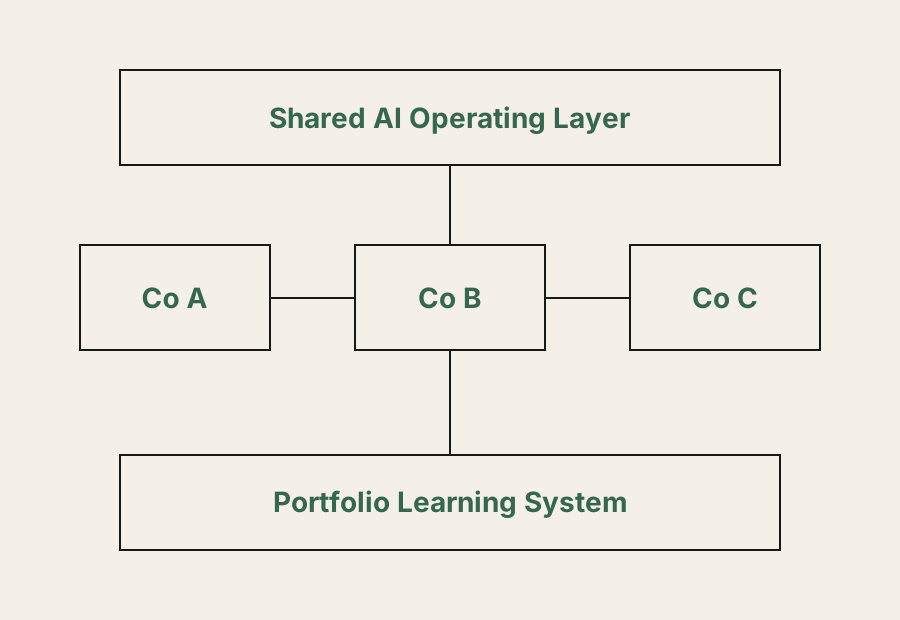
Where it started.
Contract & Implementation
`Kind: images` needs at least one frame with an image; `Kind: viewgraph` resolves a real Viewgraph by slug.
lib/motifs/reel.mjscomponents/motifs/Reel.tsx
From Editorial To Analytical
feature-band, quote-panel, and reel above form the shared editorial family. lens, matrix, and drilldown below form the shared analytical family: a compact vocabulary for moving from interpretation to structured evidence without turning every analytical section into a chart.
Lens
Purpose
The same analytical object, read through 2–3 authored interpretations without changing the underlying object.
Authoring
**Default:** authority

#### authority
**Label:** Authority
Who may act, and how far.

#### exposure
**Label:** Exposure
What is at stake if they act.
Live Result
Who may act, and how far.
What is at stake if they act.
Contract & Implementation
2–3 panels; every panel labelled and non-empty; `**Default:**` must resolve.
lib/analytics/lens.mjscomponents/analytics/Lens.tsx
Matrix
Purpose
Categorical or ordinal state across two dimensions — a semantic evidence surface, not a spreadsheet.
Authoring
**Columns:** Sense | Act
**Scale:** presence

#### copilot
**Label:** Copilot
**Cells:** full | absent
Live Result
| full | absent |
Contract & Implementation
`**Columns:**` required; a scale or `**States:**` declares the vocabulary; every row needs one cell per column.
lib/analytics/matrix.mjscomponents/analytics/Matrix.tsx
From Pattern To Inspectable Evidence
lens changes the authored interpretation and matrix exposes categorical structure. drilldown takes the next step: it preserves a compact overview while placing the evidence for an individual case one deliberate action away.
Drilldown
Purpose
Every item expandable — title, summary, and detail; one row open at a time.
Authoring
#### copilot
**Title:** Copilot
**Summary:** Assisted, human-triggered.
Detail: bounded to one task, no autonomous initiation.
Live Result
Assisted, human-triggered.
Detail: bounded to one task, no autonomous initiation.
Contract & Implementation
Every item needs a Title, a Summary, and detail content.
lib/analytics/drilldown.mjscomponents/analytics/Drilldown.tsx
Journal-Native Markers — Live
Purpose
A banded Markdown table — the one supported Journal table treatment.
Authoring
> [!table-banded]
> | Motif | Field |
> |---|---|
> | highlight | Journal |
Live Result
| Publishing field | Structural parser | Field registry and notes |
|---|---|---|
| Stories | parseStoryboard | `lib/render/motifs.mjs` — motif registry, treatments, and the field spacing adapter |
| Journals | parseMarkdownDocument | lib/journal/sidecars.mjs — the editorial-marker promotion pass, including this [!table-banded] treatment |
| Viewgraphs | loadViewgraphsFromPath | lib/viewgraphs/model.mjs — fixed 1600×900 logical geometry, its own Mermaid theme |
| Groves | parseGrovePage | lib/groves/motifs.mjs — native motifs plus the live-specimen Developer Guide infrastructure |
Contract & Implementation
A `[!table-banded]` marker wraps an ordinary Markdown table; no other table treatment is supported.
lib/journal/sidecars.mjscomponents/render/ContentBlocks.tsx
Journal-Native Markers — Reference
The rest of the Journal-only markers
Marginal content on the left, with an optional accent variant (`-red`, `-green`, `-blue`).
> [!sidecar-left]
> A note in the margin, anchored in source order.The same contract, on the right.
> [!sidecar-right]
> A note in the margin, anchored in source order.A callout marking one passage as worth a second look.
> [!highlight]
> A short passage the Journal wants the reader to notice.A small bounded set of cards inside Journal flow.
> [!cards]
> #### First
> A short card.
Grove-Native Motifs
| Motif | Job | Live on |
|---|---|---|
threshold | Opening identity, proposition, atmosphere | Grove Runtime |
statement | One idea, strong spatial authority | This page, Start Here |
artifact | An object dominates the section | Grove Runtime |
evidence | Claim plus concrete evidence | Architecture & Validation |
sequence | Ordered conceptual progression | Architecture & Validation |
passage | Movement through states | Grove Runtime |
field | Landscape of related domains | This page, Publishing Fields |
constellation | Relationships among concepts | Architecture & Validation |
ledger | Dense structured information | This table |
outcomes | A small number of high-value quantities | Extending Musewoods |
voices | People and perspectives | Grove Runtime |
origin | Long-form origin prose, never fragmented | Start Here |
principles | Named enduring commitments | Extending Musewoods |
portal | Deliberate navigation, not CTA buttons | Start Here |
grow | The living, editorial edge | Grove Runtime, Publishing Fields |
collection | Existing content, referenced not copied | Grove Runtime |
Reference Matrix
| full | full | |
| full | full | |
| full | full |
Current counts belong to System Health; this Matrix tracks whether each public authoring surface is both explained and exercised.
Ground Is Metadata, Not A Motif
Story Ground belongs on the metadata section
A Story may choose one of the governed Ground values at the page boundary. The field is optional; omission resolves to
soil. Ground is not a section motif, not a per-movement treatment, and not browser dark mode.## Meta **Render:** metadata **Title:** Example Story **Canonical:** https://musewoods.com/example-story **Ground:** forest-floorGrove Ground belongs in `manifest.yaml`
A Grove declares the same environmental choice as
ground.mode. The shared vocabulary is the same, but the authoring location follows the local-site contract rather than Story metadata. Components consume semantic tokens; they do not branch into a second component tree merely because the resolved Ground is Forest Floor.ground: mode: forest-floorViewgraph surface remains a separate contract
Viewgraphs may vary their visual surface through the Viewgraph model, but that is not another spelling of Story/Grove Ground. Embedded Viewgraph frames reassert their own canonical presentation tokens so a surrounding Forest Floor Story or Grove cannot accidentally re-tone the frame.
Coverage
tests/developer-guide-coverage.test.mjs compares the Guide coverage ledger with the live capability model in both directions. The important rule is that a renderable capability earns live coverage only from a production **Render:**/**Chart:** directive or an explicitly registered live specimen; a fenced source example by itself is documentation, not execution.
That distinction keeps this page useful as a reference without confusing code samples with regression evidence. Public Story and Journal capabilities can be covered through their dedicated production specimens, while Grove-native capabilities can point to real renders inside this Guide. System Health then reports the current registry counts and whether those coverage relationships still hold.